Electromagnetic radiation from across the observable universe — from fast radio bursts to magnetars, pulsars, and processes still poorly understood — passes through Earth's vicinity continuously. Decades of astronomy have been spent identifying sources, resolving spectra, and mapping positions. CERP asks a question that has not been systematically answered: how much energy is actually arriving — not from one source or in one band, but as a total, measurable physical quantity, in proper units, across the sky and across time.
CER — Cosmic Energy Radiometry — is not a telescope program. It is a measurement program, and the distinction is structural. Telescopes are built to look at things; CER is built to measure something specific: the integrated energetic flux of cosmic electromagnetic radiation, expressed in standardized units, with documented uncertainty, in a way that can be independently reproduced anywhere in the world. The closest precedent is Earth-observation radiometry, where instruments quantify incoming solar flux with high precision — not to study the Sun, but to measure the energy the planet actually receives. CER applies that same metrological rigor to the cosmic electromagnetic environment, and introduces both a new instrument class — the CER Energetic Radiometer — and a new measurement methodology governing acquisition, calibration, processing, and archival.
The program is organized around this principle of honest sequencing across five phases. Phase 1 establishes the measurement standard through a small orbital network carrying the CER instrument suite, with data calibrated, archived, and published. Phases 2 and 3 develop and deploy dedicated instrumentation and conduct the first systematic orbital energetic survey. Phase 4 builds the CER Reference Database — the first quantitative record of cosmic electromagnetic flux as a physical resource. Phase 5, the engineering feasibility phase, opens only if the measurements justify it: if flux levels prove technologically relevant, the program investigates what can be done with them; if not, the program retains its full scientific value on the strength of the measurement alone.
Six of the eight scientific and technical disciplines the program touches — radio astronomy, astrophysics, signal processing, fundamental physics, artificial intelligence research, and space engineering — receive primary outputs unconditionally, from Phase 1 through Phase 4. The resulting CER observational archive will be among the largest continuous broadband electromagnetic datasets ever systematically collected from orbit, with applications spanning fast radio burst statistics, spectral energy distributions, machine learning training data, and calibration methodology. Alongside the energetic measurement itself, an independent analytical layer — Information Structure Analysis — applies formal linguistic and mathematical methods to the same datasets, asking whether these signals exhibit the formal properties of organized information, regardless of what produced them.
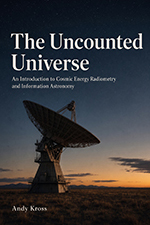
The program's technical foundation is complete: fifteen cross-referenced documents cover instrument specifications, calibration standards, data formats, interface protocols, verification procedures, phase-gate criteria, and strategic architecture. Key lectures are published in English, the companion book is available in English, French, and Russian, and supporting research has been published on Zenodo with persistent DOIs. Phase 1 is ready to begin.
| Stage | Date | Summary | Documents | Archive |
|---|---|---|---|---|
| Active | 2025 — present |
Technical foundation complete: fifteen cross-referenced documents covering instrument specifications, calibration standards, data formats, interface protocols, verification procedures, and phase-gate criteria. Three key lectures published in English. Companion book available in English, French, and Russian. Two research papers published on Zenodo with persistent DOIs.
Phase 1 ready to begin · Zenodo publications released
|
Videos · Book · Zenodo | — |